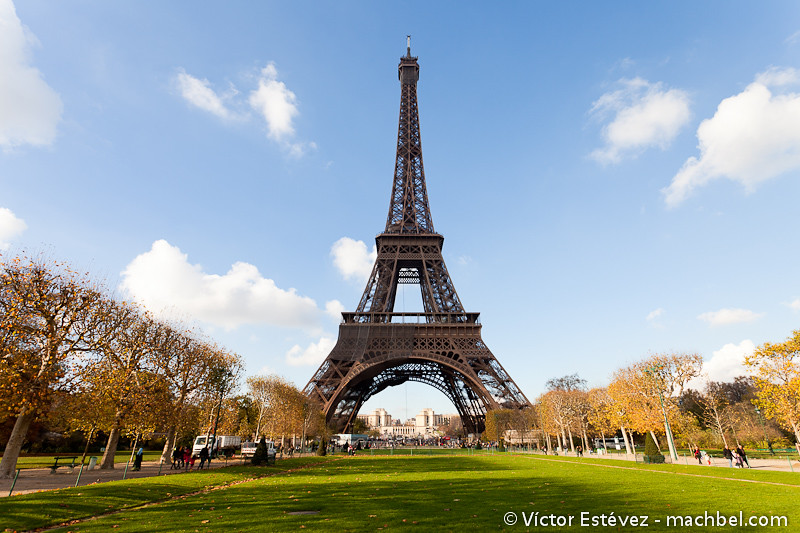
ARCHITECTURE OF THE 19th CENTUR EIFFEL TOWER
viernes, 13 de diciembre de 2013


sábado, 7 de diciembre de 2013
Funeral at Ornans
FUNERAL AT ORNANS
In this one his masterpiece, Courbet there transmits with the maximum possible realism a funeral - possibly that of his own grandfather, convinced republican, there being stated the presence of two Jacobin friends to the one that represents the whole community, from the representatives of the town hall up to the official hired mourners, happening for the noblemen and the family of the painter. Even a dog retriever does not want to get lost the event and appears in the first plane.

For comments of the own painter we know that the whole population of Ornans, wanted to pose for the picture, turning out to be a set of 46 persons to natural size represented with enormous doses of veracity it is possible to say that this work is the new artistic style defended by Courbet considered as a scientific, naturalistic, anticlassic art, antirromántico, antiacademic, progressive and socially, whose only source had to be the direct observation of the native.
The figures form a compact group and stand out on the flat mountains of the locality, represented in diverse attitudes and positions, being one of the best galleries of portraits of the history of the art. The expression of the faces that do not provoke any feeling of pain. The death has not produced in these men the pain, the distress, but they live through it as a daily fact.
Capture like models to his parents, brothers and friends, and several inhabitants of that locality, and are assembled by it in a collective portrait.
A bar of Foliate Bergère
A BAR OF FOLIATE BERGÈRE
Manet was a frequent client of Foliate Bergère. It was the musical bar, coffee-concert, cabaret frequently used by the proletariat, but, due to the experiences that were lived inside, he acquired reputation between the bourgeoisie also. Manet tells it to us in his picture. It is that alone to be fixed in the details, bottles of wine, champagne, liquor of mint for those more beneficiaries and beers for the rest.
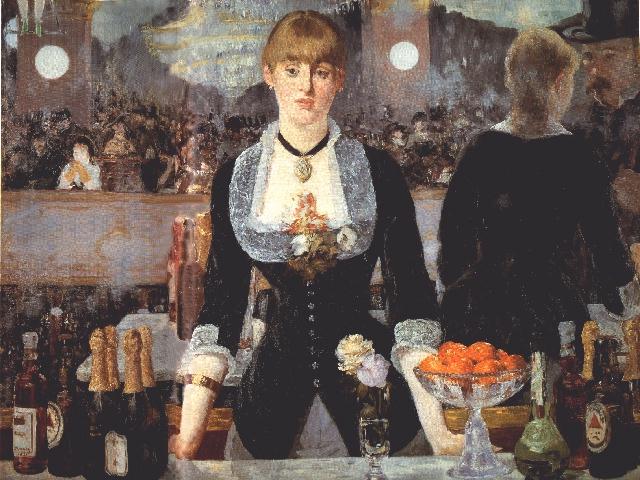
This night it was of juggling, Manet took charge showing it to us. The feet of an acrobat are seen in full act, in the top left corner of the picture. But the most important thing always was the bar. The clients were imposed on them to have the full glass periodically.
Manet was sick to the moment to paint it so it moved everything what he reminded of Foliate Bergère to his study, bottles of liquor, the waitress Suzon and fruits, this way to reproduce the moment.
The dummy
THE DUMMY
The resultant tapestry of this carton was destined for the decoration, " of matters of rural and jocular things ", of the office of Carlos IV in the palatial zone of The St Lawrence of El Escorial, manager in 1790 and last project of this kind realized by Goya. Two sketches are known for this set, of The young girls of pitcher and of The dummy.
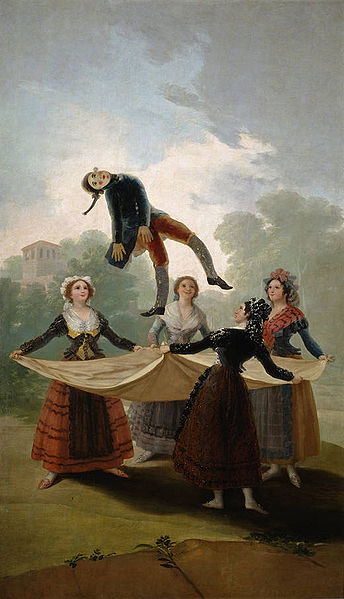
Four young women dressed in beauties toss in a blanket a dummy in an environment of leafy landscape, crossed by a river, with the presence of a building of stone to the bottom. The game practised during some popular holidays and rite of farewell of the bachelorhood, symbolizes here the power of the woman on the man, general matter of this set and repeated in the work of Goya, with examples in the series of engravings of the Caprices and of the Silly things, as well as in his álbumes of drawings.
The Pantheon of París.
THE PANTHEON OF PARIS
The Pantheon in Paris was the first monument of the French capital. Its construction is previous to the monuments like the Eiffel Tower and was the first place where you could see Paris from the heights. It is located in the Latin Quarter, near the Luxembourg Gardens.
 The Pantheon of Paris
 Inside of the Pantheon of Paris
 Sculpture in the Pantheon of Paris
The Pantheon could divided it into two parts: the interior of the building, where impressive to see the size of it and its decoration, and on the other part the crypt, where currently you can find the bodies of famous people such as Voltaire, Rousseau, Victor Hugo, Marie Curie, Louis Braille, Jean Monnet or Alexander Dumas.
sábado, 30 de noviembre de 2013
Fusilamiento de Torrijos
FUSILAMIENTO DE TORRIJOS
Y SUS COMPAÑEROS


La reinstauración absolutista anulando la Constitución de 1812 lleva a José María de Torrijos y Uriarte (nacido en Madrid 1791) a tomar partido por los liberales, acogiendo esperanzado las cartas secretas de un amigo "de toda confianza", que le informa que el mejor lugar para desembarcar es La cala del moral y que con su presencia las tropas de Málaga primero y luego las de toda Andalucía se rebelarían contra el rey Fernando VII. En realidad se trata de una trampa por el antiguo compañero de armas, el ahora gobernador de Málaga Salvador González Moreno, quien parece que era "Viriato" y que aprovechando la impaciencia de Torrijos planeó su captura.
El rey Fernando VII firmó de su puño y letra que los fusilaran a todos, a Torrijos y a sus 52 hombres incluyendo al inglés Robert Boyd.
Torrijos y sus compañeros se equivocaron de destino pasando por la Cala de Mijas, el barco Neptuno (los que le esparaban para capturarlo) ven que va por otro lado y creen que esta escapando, y empiezan a atacar el barco de Torrijos. Éste al darse cuenta que era todo un trampa escapan buscando un escondite en la Cala de Mijas.
Huyeron hacía el interior de la Sierra de Mijas, al final Torrijos y sus compañeros se rindieron viendo que no podían escapar. Los llevaron a la cárcel, sin juicio ni nada, fueron fusilados el 11 de Diciembre de 1831 en el barrio malagueño de El Bulto, injustamente.
Torrijos y sus compañeros están enterrados en la Plaza de la Merced de Málaga, menos un irlandés; Robert Boyd que está enterrado en el cementerio ingles de Málaga.
INFORMACIÓN:
Wikipedia. Torrijos
Leccionesdehistoria
FOTOS:
FOTOS TORRIJOS
viernes, 29 de noviembre de 2013
El acorazado de maine.
EL ACORAZADO DE MAINE:

El Maine es conocido por su catastrófica pérdida en el Puerto de la Habana en la mañana del 15 de febrero de 1898. Fue enviado para proteger los intereses de los ciudadanos estadounidenses durante la revuelta cubanas contra España. Estalló de repente, sin previo aviso, perdiendo la vida en la explosión tres cuartas partes de su tripulación. Las causas de la explosión no quedaron claras en una comisión de investigación, pero la opinión pública estadounidense, avivada por las proclamas incendiarias de la prensa amarillista estadounidense realizadas por William Randolph Hearst y Joseph Pulitzer, culpó a España.
Los diarios norteamericanos The World, de Joseph Pulitzer, The Sun,de Charles Dana,el New York Herald, de Janes Gordon Bennett y muchos otros enviaron a sus fotógrafos y reporteros. Vinieron más de un centenar y todos transmitían noticias de un sensacionalismo rabioso y fotografías trágicas o falseadas, lo que constituyó una verdadera explosión de mentiras, exageraciones e inexactitudes en torno al desastre del Maine.
La frase «¡Recordad el Maine, al infierno con España!» («Remember the Maine, to Hell with Spain!») se convirtió en un grito para quienes clamaban por la guerra, que se materializó en la Guerra de las colonias ese mismo año. Aunque el hundimiento del Maine no fue la causa directa de la confrontación, sirvió como catalizador, acelerando el desarrollo de los acontecimientos.

The Maine´s battleship.
In the port of La habana the Maine's battleship was exploited and all the U.S people said that Spanish people was done it and the newspapers and the news manipuled the pictures of the blast.
Today most of U.S people thinks that was true, but a lot of other people say that the U.S did it because they wanted war with Spain to conquered Cuba, Puerto Rico and Philipines.
Información: El acorazado de maine
Wikipedia. El acorazado de maine
Fotos: El acorazado de maine. Imágenes.
Suscribirse a:
Entradas (Atom)